
The University of Oklahoma is building the only mobile, dual-Doppler Ka-band imaging radar system in the United States. QuinStar is supplying the high-power Ka-band solid-state amplifiers that drive it.
A first-of-its-kind radar
The University of Oklahoma’s Advanced Radar Research Center (ARRC) has been awarded $19.9 million by the U.S. National Science Foundation to develop two KaRVIR systems – Dual-Doppler 3D Mobile Ka-band Rapid-Scanning Volume Imaging Radars for Earth System Science. The award, made through NSF’s Mid-scale Research Infrastructure-1 program, funds development from October 2025 through September 2030.
Built on advanced millimeter-wave phased array technology, KaRVIR will be a first-of-its-kind platform: the only mobile, dual-Doppler Ka-band imaging radar system in the United States.
In partnership with ARRC, QuinStar has been selected to supply the 100 W Ka-band power amplifiers that drive these next-generation phased array radars.
Why Ka-band changes what researchers can see
Ka-band radar operates at a much higher frequency than conventional weather radar, so it responds to a significantly broader spectrum of particle sizes – from fine ash and cloud droplets to ice and heavy precipitation. That sensitivity translates directly into resolution, and resolution is what makes new science possible.
Speed is the other half of the picture. In OU/ARRC’s published system comparison, the benchmark ARM/DOE Ka-SACR requires 17 minutes for a volume scan; KaRVIR’s projected scan time is less than 20 seconds. That shift from minutes to seconds would allow researchers to watch atmospheric structures form and evolve rather than sample them one slow sweep at a time.
Researchers expect to use KaRVIR to study:
Because the platform is mobile and dual-Doppler, the instrument can be taken to the phenomenon instead of waiting for the phenomenon to cross a fixed site – a meaningful advantage for field campaigns.
A demanding job for the transmitter
No single component makes a radar work. Antenna, waveform, receiver, calibration, signal processing, and transmitter all have to perform together – and the transmitter is where RF performance, prime power, and thermal design collide.
A millimeter-wave amplifier operating at high duty puts efficiency and heat removal at the center of the design. On a mobile platform, that constraint tightens: available power, cooling capacity, weight, and volume are all finite, and the vehicle environment adds shock, vibration, and temperature extremes that a laboratory rack never sees. Through all of it, the amplifier has to hold a stable, repeatable output – because in a research radar, transmit stability is measurement accuracy.
It also has to integrate. RF, DC, cooling, mechanical, and control interfaces all have to line up with a radar being designed in parallel, on the program’s schedule.
QuinStar’s QBP-series 100 W Ka-band GaN solid-state power amplifier was selected because it answers that combination of requirements: high output power at Ka-band, pulsed and CW operation, high-efficiency power combining, and packaging built for real operating environments rather than bench conditions.
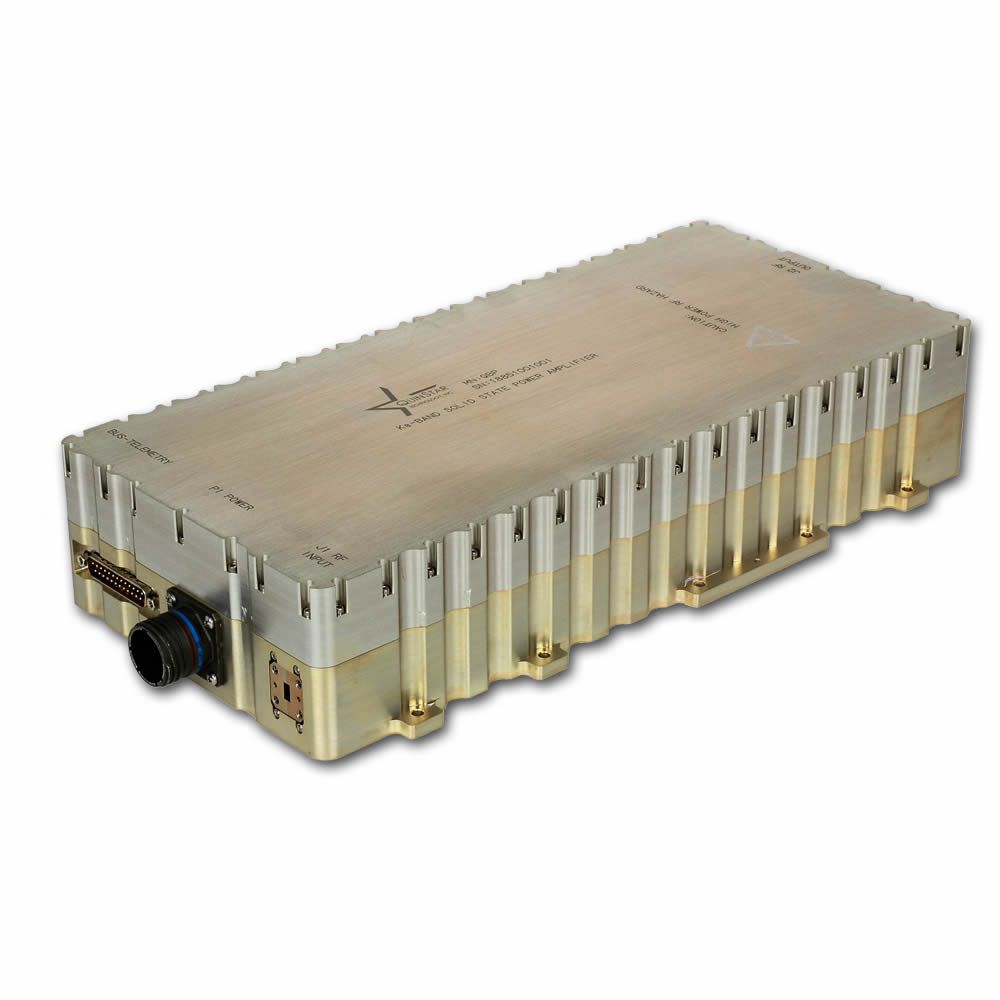
QuinStar QBP-series Ka-band solid-state power amplifier. Conduction-cooled packaging, integrated power supply and control, built for pulsed and CW operation outside the lab.
When a component decision becomes a program decision
For engineers and program teams, the gap between a data sheet that looks right and hardware that works in the system usually opens up at the interfaces – where the amplifier meets cooling, prime power, and control lines, and where a part that looked ideal on paper does not quite drop in.
Questions about performance over temperature, thermal load, power budget, packaging, test evidence, and supplier responsiveness have a way of surfacing late, when they are most expensive to answer. QuinStar works to close them early, and everything needed to do that is in-house: high-frequency amplifier design, MMIC capability, microelectronics assembly, subsystem integration, manufacturing, and environmental test.
That capability matters most for requirements that fall between a catalog buy and a ground-up development – a standard product that has to be tailored for a customer’s application. The gap is easy to underestimate, because the requirement looks straightforward until closing it turns out to take real engineering. A catalog-only supplier cannot modify the part. A design-only house may want to start from scratch. QuinStar closes the gap by combining design, manufacturing, and test to take a proven part and make it right for the program.
Built for what comes next
KaRVIR is an ambitious instrument because the science behind it is ambitious. QuinStar is proud to support the ARRC team with the high-power Ka-band hardware behind it. The real value of that hardware will show up in what researchers are able to see next.
Developing a radar, instrument, or high-frequency transmitter? Explore QuinStar’s power amplifier products, or contact our team at sales@quinstar.com to work through the RF, power, thermal, and interface details shaping your program.